Questions (answers are below)
Q1 - Are there particles in the Wave Structure of Matter model?
Q2 - How does an in-wave come in from all directions? What is an in-wave?
Q3 - What do the lines in spherical rotation illustrations represent?
Q4 - What is gravity?
More to come...
Answers
Q1 - Are there particles in the Wave Structure of Matter model?
|
There are no particles in the sense of a discrete something at their
center analogous to a grain of sand nor is there any point particle
concept. However, there are electrons, protons and neutrons. These are
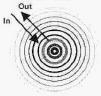
made up of concentric spherical waves. A spherical in-wave moves
inward toward the center, undergoes spherical rotation and then moves
outward from the center as a spherical out-wave. Combined, their
amplitudes add up to a spherical standing wave. It is impossible to
say where the electron starts and ends since it is made up of only
these waves and these waves potentially propagate endlessly.
Also, a portion of the out-wave of one electron is a portion
of the in-wave of another electron, so even the boundary between
electrons is hard to define.
|
|
The terms wave-center and spherical resonance are more suited to the WSM model than
particle as wave-center refers to the location where the in-wave undergoes
spherical rotation to become the out-wave. It is also this wave-center that
moves, that gives the appearance of mass in the influence of gravity, has
momentum, ... The term particle can be used to mean this wave-center as long
as it is understood that there are no discrete particles.
For more information see the article
"The Wave Structure of Matter (WSM) and the Origin of Natural Laws" by Milo Wolff.
Q2 - How does an in-wave come in from all directions?
What is an in-wave?
|
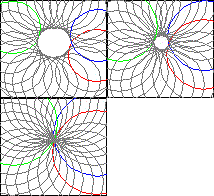
As the animation on the right illustrates, an in-wave is really a collection
of separate spherical waves coming from many different particles. At one
common edge, all these in-waves form a single wavefront that is the in-wave.
In the animation it's where all the waves meet to form a dark, collapsing ring.
This is called Huygens principle (or more precisely, the Huygens-Fresnel principle.)
The red, blue and green waves in the animation are so colored to help show
that the animation is made up of many separate circular waves.
So only a small portion of the out-wave of one particle arrives at a second
particle as part of that second particle's in-wave. That small part will then
be rotated 720 degrees, and returned to the original particle as part of a new,
expanding out-wave.
|
|
Q3 - What do the lines in spherical
rotation illustrations represent?
|
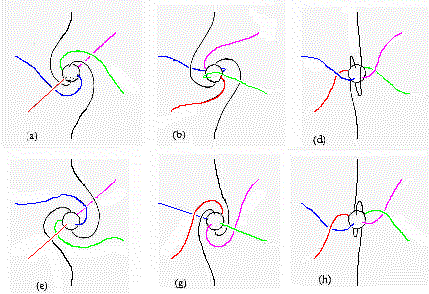
The lines represent the path that the in-waves and out-waves take as
they arrive and leave the wave center (particle.) But at the same they
also represent the shape of space.
Space energy density at any location
is
proportional to the sum of the intensity of all the waves at
that location. The intensity of a wave is the wave's amplitude
squared. Gradients in space energy density are followed by waves as
the waves move through space - and partcles are made of waves. So
particles move according to space energy density gradients
(e.g. cause of gravity.) In
effect the energy density gradients define the shape of space since
it's these gradients that particles follow.
So back to the question... The moving, twisting waves within the
particle center are shaping the space energy density/shape of space.
Saying that the lines represent the path of the waves is also saying
that the shape of space is twisting and untwisting.
|
|
Q4 - What is gravity?
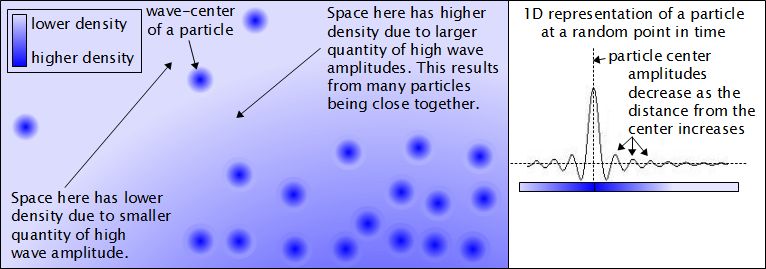
Gravity is a movement of particles from lower density space to
higher density space. The density of a location in space
is
proportional to the sum of the intensity of all the waves at
that location and represents the energy at that location.
The intensity of a wave is the wave's amplitude
squared. The waves at that location originate from all particles
within that location's Hubble sphere (a sphere whose radius is the
Hubble length.)
Areas where there is higher density are areas containing more
particles. This is because the amplitude of a wave around a
particle is higher the nearer the particle and lower the
farther away you go from the particle. So if you have many
particles near each other then the amplitudes making up the
density in that area are all high amplitudes. This is in keeping
with the observation that the more mass you have the higher the
gravity resulting from that mass.
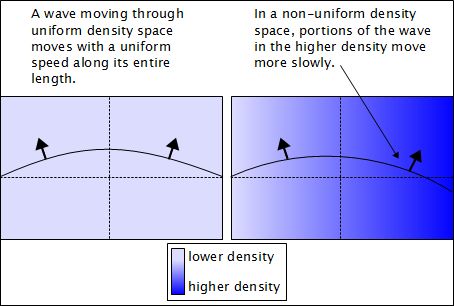
But why would this cause a particle to move toward an
area of higher density? The key, as the following diagram
illustrates, is that a wave moving
through an area of uniform density space will continue on
its way unaffected. However, if any portion of that
wave were to encounter an area of space with higher density
then that portion of the wave would move more slowly than
the rest.
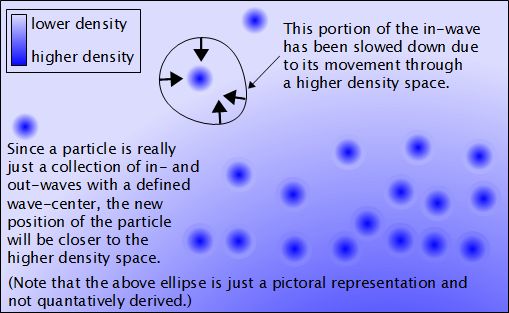
Particles are really just areas of space where in-waves
are arriving, undergoing spherical rotation and then
leaving again as out-waves. If a portion of an in-wave
is moving slower than the rest because it is in a higher
density space, then already the particle has moved toward
the higher density area since the in-wave is a portion
of the particle.